

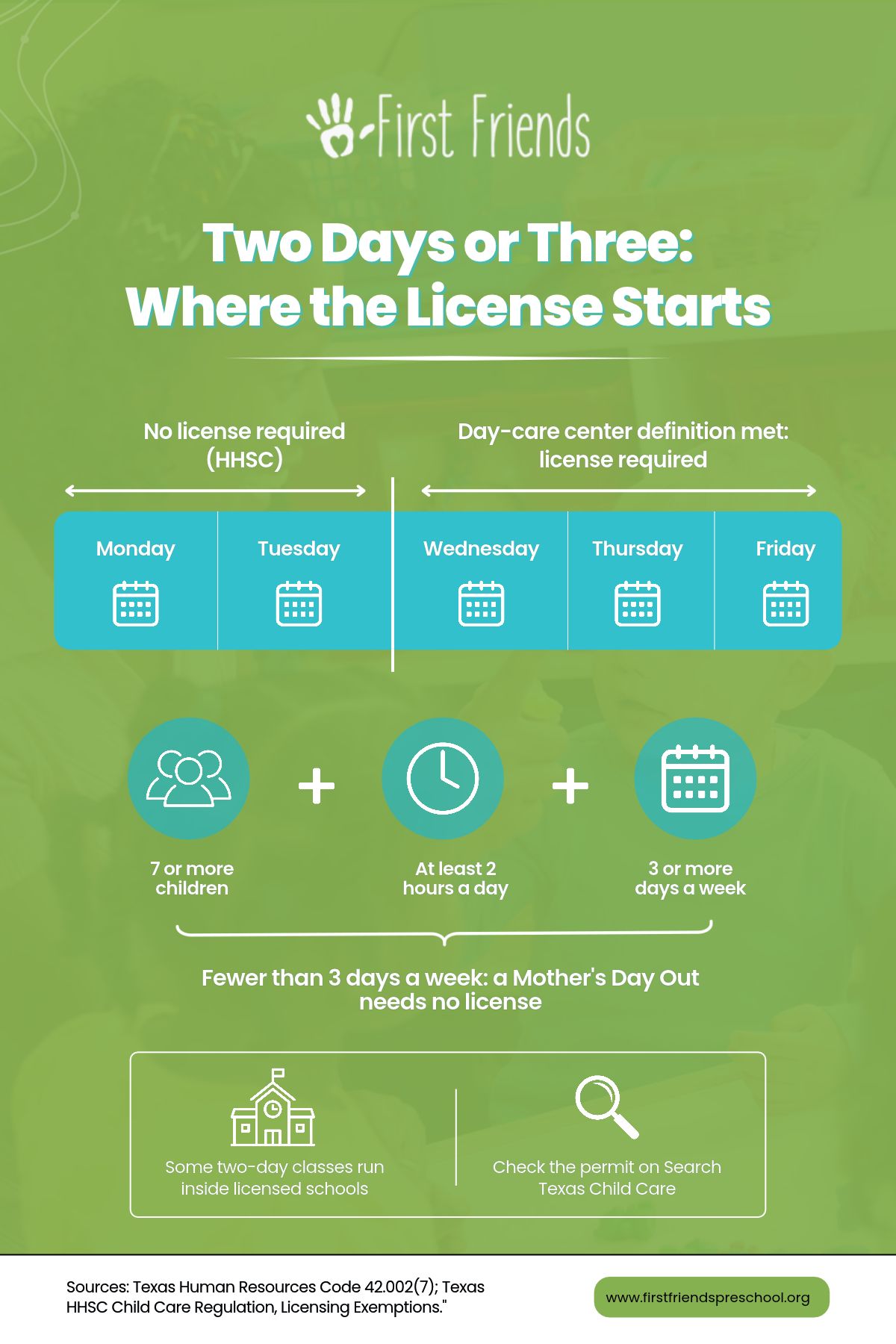
The name on the sign tells you less than the number of days on the schedule. In Texas, a program caring for seven or more children at least two hours a day on three or more days a week meets the state’s definition of a day-care center, and that needs a license. A Mother’s Day Out that runs fewer than three days a week does not, according to the state’s own child care regulators. So before comparing crafts, chapel, or snack, count the days, then ask for the permit.
TL;DR
The practical difference in the mother’s day out vs preschool question in Texas is regulatory, and it turns on days per week. Texas Human Resources Code section 42.002 defines a day-care center as care for seven or more children, at least two hours a day, three or more days a week. Texas Health and Human Services Child Care Regulation states that a Mother’s Day Out operating fewer than three days a week does not require a license. A two-day program may therefore be unlicensed and entirely lawful, while a three- or four-day program of that size needs a permit and gets inspected. Names vary: some two-day classes run inside licensed schools, and some programs called Mother’s Day Out hold a license anyway. The reliable check is to ask whether the program holds a state permit and then look it up.
Where Does Texas Draw the Line Between the Two?
Texas draws it at three days a week. The definition sits in Texas Human Resources Code section 42.002, subsection 7, which describes a day-care center as a facility caring for seven or more children under 14, for less than 24 hours a day, “but at least two hours a day, three or more days a week.” Section 42.041 of the same chapter then says nobody may operate a child-care facility without a license.
The regulator applies that line directly to the programs parents in Prosper and Frisco are searching for. On its page of HHSC Child Care Regulation licensing exemptions, the agency answers the Mother’s Day Out question in one sentence: if the program operates fewer than three days a week, a license is not required. Add more days and the operation has to apply for a permit.
| Program shape | Meets the day-care center definition? | License needed? |
|---|---|---|
| Seven or more children, 2+ hours a day, 1 or 2 days a week | No, under three days | No, per HHSC’s exemption guidance |
| Seven or more children, 2+ hours a day, 3 or 4 days a week | Yes | Yes |
| Short care while parents attend a service or class on site | Exempt under section 42.041(b)(3) if conditions are met | No, and the program must tell parents it is not licensed |
That last row matters for church campuses. The same statute exempts care provided for short periods while parents attend religious services, shop, or take part in other activities on or near the premises, provided the program does not advertise itself as a day-care center and tells parents it is not licensed by the state. Nursery care during a Sunday service is the familiar example. A weekday class that parents drop off at and leave is a different thing.
What the Two Names Usually Mean
Neither “Mother’s Day Out” nor “preschool” is a permit type in Texas. The words describe what a program intends to be, and the state regulates what it actually does.
Mother’s Day Out began as a name for a few hours of care that gave a parent at home some time back. Preschool is a name for early learning before kindergarten. In practice, the two overlap heavily around Collin County, and plenty of programs use one name while running something closer to the other. We are a state-licensed church preschool, a ministry of First Baptist Church Prosper, and we still get calls from families asking whether we are a Mother’s Day Out. The honest answer is that the label matters less than the schedule and the permit.
Here is what to compare instead of the name:
- How many days a week the program runs, for any child, not just for yours
- Whether it holds a permit from Texas HHSC Child Care Regulation
- What happens during the hours your child is there
- Which calendar it follows, and what it costs per month
- Whether a before or after care option exists, and who runs it
Why "for any child" is the question to ask
The state’s internal handbook frames the test slightly differently from the public page. In the decision guide in Appendix 2000 of the Child Care Regulation Handbook, licensing staff ask whether the children are in care for more than two days a week, and whether the care runs for three or more consecutive weeks. A program with Monday and Wednesday classes plus separate Tuesday and Thursday classes is open four days even though each child only comes twice.
We are not the right people to decide how the state would treat any particular program, and you don’t need to be either. That is exactly why the permit question is simpler than the schedule question. Ask for the permit, then check it.
A Two-Day Class Inside a Licensed School
Your child can attend two days a week without the program being a two-day program. We run Monday through Thursday, 9 am to 2 pm, and our two-day classes sit inside that same weekly schedule alongside our three- and four-day classes.
A stand-alone program that only opens on Tuesdays and Thursdays is the reverse case. It can operate lawfully without a license under the HHSC guidance above, which is not a mark against it. It does mean you are relying on your own questions rather than a public inspection record.
How Many Days a Week Does Each Age Group Attend Here?
| Class | Days offered | Day pattern | Age on our tuition page |
|---|---|---|---|
| Toddlers | 2 days | Monday/Wednesday or Tuesday/Thursday | 18 months by September 1 |
| Twos and threes | 2 days | Monday/Wednesday or Tuesday/Thursday | 24 months to 3 years |
| Twos, threes and fours | 3 days | Tuesday/Wednesday/Thursday | 2, 3 or 4 by September 1 |
| Threes and fours | 4 days | Monday through Thursday | 3 or 4 by September 1 |
| Private Kindergarten | 4 days | Monday through Thursday | 5 by November 1 |
One rule on our programs page changes the choice for some families: beginning at 3 years old, children must be potty trained to begin classes. That applies whichever day pattern you pick.
We are not going to tell you that a particular number of days is right for a particular child. Families choose for different reasons, and the most common one we hear is simply the shape of the parents’ own week. Options narrow as children get older, so a family planning a two-day year at age three and a four-day year at age four is working with what the schedule actually offers.
What Does an Extra Day Cost at Our School?
| Schedule | Monthly tuition | Monthly security fee | Monthly total | Per weekly day slot |
|---|---|---|---|---|
| 2 days | $335 | $20 | $355 | $177.50 |
| 3 days | $405 | $30 | $435 | $145.00 |
| 4 days | $465 | $40 | $505 | $126.25 |
Moving from two days to three adds $80 a month once the security fee is included. Moving from three to four adds $70. The one-time registration fee listed there matches the monthly tuition figure for each schedule, so it steps up by the same amounts, and the page gives a sibling discount to the second and third child enrolled.
Our before and after school care runs Monday through Thursday as a separate program, and it is priced separately, so ask the office for that figure rather than estimating it from the table.
For a family in Celina or Little Elm weighing a stand-alone two-day program closer to home against a longer drive to Prosper, the per-slot column is the fairer comparison. Monthly totals hide how many mornings you are actually buying.
Checking a Program's Permit Before You Commit
Texas publishes inspection reports for the child care operations it regulates, and a program with no permit has no inspection record to publish. Two minutes on the state’s search tool tells you which kind of program you are looking at.
- Ask the program directly whether it holds a permit from Texas HHSC Child Care Regulation, and what type.
- Search the operation’s name or ZIP code on Search Texas Child Care.
- If it appears, read the permit type, the inspection history, and any deficiencies.
- If it does not appear, ask how many days a week the program operates in total, and whether it tells parents in writing that it is not licensed.
- Match what you heard on the phone against what you see on the tour.
We wrote a separate walkthrough on reading a childcare licensing record that covers the weighting of deficiencies and what a monitoring inspection is, so we will not repeat it here.
For licensed centers, the rules they are inspected against are the state’s minimum standards for child-care centers, Chapter 746, published by HHSC. The same agency investigates reports about operations it believes are providing care without a permit, which it calls unregulated operations. Neither fact makes an exempt program unsafe. They tell you who is checking.
The Local Calendar Detail Nobody Mentions
Day pattern also changes which events your child is in the room for. It sounds minor until it is your child who missed the class party.
Our calendar splits several events across the week. The Happy Birthday Jesus parties, for example, all fall on one day except for the Monday and Wednesday classes, and the Child of the King parties are set up the same way. A Monday and Wednesday family and a Tuesday and Thursday family see a slightly different year.
The closures follow the local district too. Several of our closed days are listed on the calendar as Prosper ISD school holidays, which helps families with an older sibling at a Prosper ISD campus in Collin County or Denton County, since the younger child is home on the same days. If your older child attends school in McKinney, Frisco, or Aubrey instead, compare the two calendars before choosing days, because a two-day pattern can land differently against another district’s holidays.
Questions Worth Asking on Any Tour
Whatever name the program uses, the same short list sorts most of them, and we are glad to answer each one about ourselves.
- Do you hold a permit from Texas HHSC Child Care Regulation?
- How many days a week is the program open in total?
- Which day patterns are open for my child’s age this year?
- What calendar do you follow, and when are you closed?
- Is before or after care part of the same program?
Our registration page lists current openings by class and day pattern. If the real choice is a half-day school against full-day care, our comparison of preschool and daycare in Prosper covers that separate question.
Tour With Your Days Already Picked
Choose the days before you choose the program. Write down which mornings you actually need, whether the older siblings’ district calendar matters, and whether a license is a requirement for your family or a preference. Then call two or three programs and ask the same questions of each.
If a licensed, faith-based school with two-, three-, and four-day options fits that list, we would be glad to show you around. Tours at First Friends Preschool run Monday through Thursday by appointment, and you can read more about who we are on our about page. Families come to us from Prosper, Celina, McKinney, Frisco, Little Elm, and Aubrey, and the question we hear most on those tours is the one this page answers: how many days, and does it need a license?
Frequently Asked Questions
What is the difference between Mother's Day Out and preschool?
In Texas, the working difference is usually days per week and licensing. HHSC says a Mother’s Day Out operating fewer than three days a week needs no license. A program of seven or more children running three or more days a week meets the day-care center definition and must be licensed.
Does a Mother's Day Out program need a license in Texas?
Not if it operates fewer than three days a week, according to Texas HHSC Child Care Regulation. Once it runs three or more days a week for seven or more children, at least two hours a day, it falls under the statutory day-care center definition.
Is First Friends Preschool a Mother's Day Out?
We are a state-licensed church preschool, a ministry of First Baptist Church Prosper. We offer two-day classes for younger children alongside three- and four-day classes, all running Monday through Thursday, 9 am to 2 pm.
Can my child attend two days a week at First Friends?
Yes, for toddlers and for children from 24 months to 3 years, on Monday and Wednesday or Tuesday and Thursday. Pre-K fours choose three or four days, and Private Kindergarten runs four days a week. Our registration page shows current openings.
How do I check whether a program holds a state permit?
Ask the program for its permit type, then search its name or ZIP code on Search Texas Child Care, the state’s public lookup. Licensed operations show their inspection history there. A program with no permit will not appear at all.