

The main difference is schedule and purpose. A half-day preschool runs a shorter school-year day (ours is 9 am to 2 pm, Monday through Thursday) and centers on early learning through play. A daycare usually offers full-day, year-round care built around a working parent’s hours. Neither is better; they answer different needs.
If both parents work full time and need coverage from early morning to evening every weekday, a full-day daycare fits. If your child is ready for a structured early-learning setting and your family can manage a shorter day, a half-day preschool fits. In Prosper, both preschools and daycare centers that serve seven or more children are licensed by the state under the same minimum standards, so licensing is a floor to check, not the thing that separates the two.
What Most Prosper Parents Are Actually Deciding Between
Parents call us thinking the choice is “preschool versus daycare,” but the real question underneath is usually about hours and cost, and what they want their child’s day to look like. Below we walk through how the two models differ in Texas, who each one tends to fit, what half-day hours mean for a working family, the licensing and safety points worth checking in Collin County, and the honest cost ranges families here run into. We also cover the registration timing that catches a lot of Prosper families off guard, since the popular programs fill months ahead. By the end, you will know which direction to look, and what to ask on a tour before you commit.
Preschool vs Daycare: The Real Difference in Texas
The words get used interchangeably, and that causes a lot of the confusion. Here is how they actually differ in practice.
A daycare (the state calls these child-care centers) is built around care and supervision, usually full day and year-round, so parents can work. Many daycares serve infants through school age and stay open roughly 6:30 am to 6 pm. Learning happens, and good daycares include play-based activities, but the schedule is designed first around coverage.
A preschool is built around early learning on a school-year calendar. Days are shorter, sessions are part-time, and the age range is narrower, typically walking toddlers through age five. A half-day preschool like ours runs 9 am to 2 pm, Monday through Thursday, and follows a calendar close to the local school year rather than staying open all summer.
One point that surprises people: in Texas, the license itself does not separate the two. Both preschools and daycare centers caring for seven or more children in a group setting are regulated by the Texas Health and Human Services Commission under Chapter 746, the Minimum Standards for Child-Care Centers. The same staff-to-child ratios apply to both. So “we’re licensed” is not what makes a program a preschool rather than a daycare. The schedule, the age range, and the focus on early learning are.
How the daily schedule really differs
A full-day daycare day might include arrival any time in a wide window, breakfast, morning activities, lunch, a long nap, afternoon play, and a late pickup. A half-day preschool day is compressed and intentional: arrival at a set time, circle time, a learning focus, centers and play, a shared snack or lunch, then pickup by early afternoon. The shorter day is a feature for some families and a constraint for others, which is exactly the thing to be honest with yourself about.
Who a Half-Day Preschool Actually Fits
We are a play-based, faith-based preschool on the First Baptist Church Prosper campus, so we see a specific slice of families do really well here, and we will tell you plainly when a different setup would serve you better.
A half-day program tends to fit when:
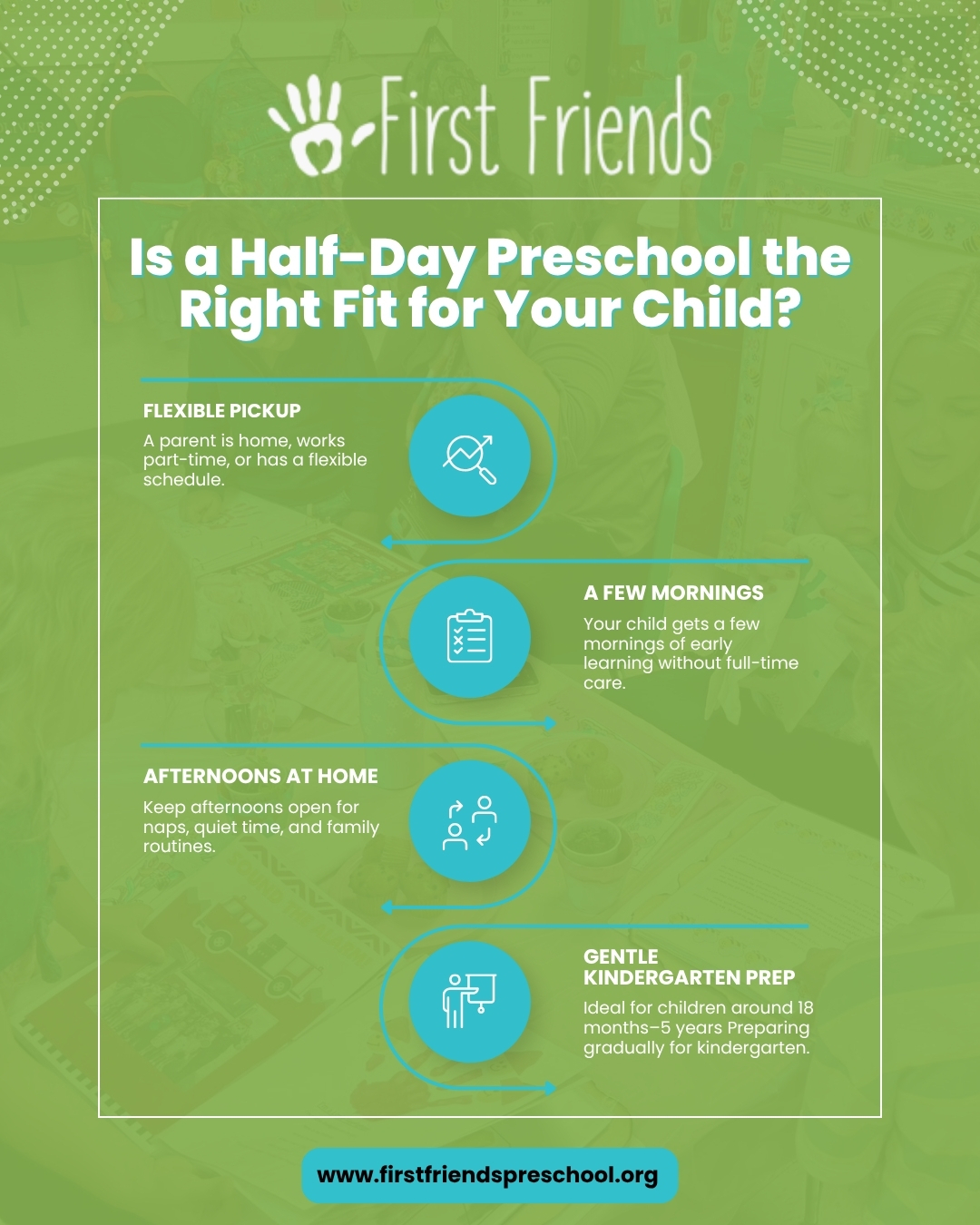
- One parent is home, works part-time, or has flexible hours that cover a 2 pm pickup.
- You want your child in a structured early-learning setting a few mornings a week, not full-time care.
- You would rather your child have afternoons at home for naps and downtime.
- Your child is between about 18 months and five, and you are building toward kindergarten readiness at a gentle pace.
It usually does not fit when both parents work standard full-time hours with no one available midday and no backup for the after-2 pm gap. In that case, a full-day daycare, or a preschool paired with an after-care option, is the more realistic answer. Some Prosper families do bridge the gap by combining a morning preschool with a nanny or a grandparent for the afternoon, and that works, but only when the logistics are genuinely covered, not just hoped for.
A note for families comparing a church preschool to a daycare
Faith-based does not mean less educational. Our program is play-based and developed with input from professional educators, with a simple Bible component woven in. If a faith element matters to your family, a church preschool adds that. If it does not, that is completely fine, and you would weigh a program purely on schedule, staff, and environment.
Licensing and Safety: What to Check in Collin County
This is the part worth slowing down on, because it is where “your money or your life” stakes are real: this is your child’s safety.
Every licensed center in Prosper, whether it calls itself a preschool or a daycare, has to meet the same Texas minimum standards. Under Chapter 746, the required staff-to-child ratios are:
|
Age group |
Maximum children per caregiver (state minimum) |
|
Infants (under 18 months) |
1:4 |
|
Toddlers (18 to 36 months) |
1:11 |
|
Preschool age (3 to 5 years) |
1:12 |
|
School age |
1:15 |
Those are ceilings, not targets. Plenty of quality programs choose to run smaller groups than the maximum. When you tour a program in Prosper, ask what their actual ratios are, not just whether they meet the minimum.
A few other things worth checking on any tour, preschool or daycare:
- The center’s current license status and any recent inspection history (Texas publishes this; you can look it up before you ever visit).
- Staff background checks and training, and how long teachers have been there.
- Drop-off and pickup security procedures.
- How they handle allergies, medication, and illness policies.
Licensing is the floor. What happens above that floor- the people, the ratios a program actually keeps, the feel of the room- is what you are really evaluating.
What It Costs: Honest Ranges for Prosper Families
Cost is where a lot of comparisons quietly fall apart, so here are real ranges rather than a single made-up number. Treat these as directional, since every family’s days-per-week and program choice changes the math.
Full-day daycare in the Prosper and broader Collin County area generally runs on the higher end because you are paying for full-day, year-round coverage, often per week or per month per child. A half-day, school-year preschool typically costs less per month than full-time daycare, because you are paying for fewer hours and a shorter calendar, though the per-hour rate is not always lower.
For our own program, tuition varies by which program and how many days per week your child attends, and there is a one-time registration fee (which ranges by program and includes a t-shirt), plus a monthly security fee. We also give a sibling discount for the second and third enrolled child. The most accurate way to compare is to price the exact days-per-week you need at each place, then add registration and any monthly fees, rather than comparing headline numbers. Our current figures are on our tuition page.
One honest trade-off: a half-day preschool almost always looks cheaper per month, but if you then need to pay for afternoon care separately, the combined cost can meet or pass a full-day daycare. Run the full picture before you decide.
What a Play-Based Preschool Is Actually Building Toward
Parents sometimes worry that “play-based” means their child is only playing, and not getting ready for kindergarten. In practice, play is how young children build skills. When a child sorts blocks by color, negotiates a turn at the sensory table, or retells a story from circle time, they are building the early math, language, and social skills that kindergarten expects. A good preschool is intentional about it, with teachers guiding the play toward specific skills rather than just supervising a room.
That is different from what a full-day daycare is optimized for, which is safe, nurturing care across a long day. Many daycares include genuine early-learning activities, and the best ones are wonderful. The distinction is one of emphasis: a preschool’s whole day is organized around a learning progression on a school-year arc, while a daycare’s day is organized around coverage first, with learning layered in.
For families weighing this in Collin County, it helps to picture the next step. If your child will head into a Prosper ISD kindergarten, a preschool that runs on a similar school-year rhythm eases that transition, since the calendar and daily routine already feel familiar. If your priority is instead reliable all-day care while both parents work, that transition matters less than dependable hours. You can see how our specific classes map to each age on our registration and programs pages.
The Registration Timing Nobody Warns You About
Here is the practitioner-level thing we wish more Prosper families knew: the popular programs fill far earlier than parents expect. We open 2026 to 2027 registration well before the school year starts, and specific class and day combinations (Pre-K and the popular two-day and three-day options) can reach capacity months in advance. Families new to Prosper often assume they can enroll in late summer for a fall start, then find the spot they wanted is gone.
Prosper has grown fast, and demand for both preschool and daycare in this part of Collin County has grown with it. If you have a target program and a specific number of days in mind, get on the radar early, ask about waitlists, and schedule a tour before you have fully decided. Tours here are by appointment, Monday through Thursday, which itself tells you something: a half-day school-year program keeps school-year hours.
A Simple Checklist Before You Choose
Before you commit to either a preschool or a daycare in Prosper, walk through this:
- Map your actual weekly hours. Does a 9 am to 2 pm window work, or do you need full-day coverage?
- Decide what you want the day centered on: care and coverage, or structured early learning.
- Confirm the license status and ask for the real staff-to-child ratios, not just the minimums.
- Price the exact days-per-week you need, plus registration and monthly fees, at each option.
- Factor afternoon or summer care if a half-day, school-year program leaves a gap.
- Tour in person. Watch how staff talk to the children. That tells you more than any brochure.
- Ask about registration timing and waitlists early, because good programs fill ahead.
Answer those seven honestly, and the preschool-or-daycare question usually answers itself.
Where to go from here
Choosing between preschool and daycare in Prosper comes down to your family’s hours, your budget, and what you want your child’s day to hold, not to which label sounds better. A half-day play-based preschool and a full-day daycare both have their place, and the right one is simply the one that fits your real life. If a warm, faith-based, play-based half-day program on a school-year calendar sounds like your family, we would love to show you around. You can see our programs and current tuition, then book a tour with First Friends Preschool when you are ready to take a look in person.
Frequently Asked Questions
How do I choose preschool or daycare in Prosper for my family?
Start with your weekly hours. If you need full-day, year-round coverage, a daycare fits; if a shorter school-year day works and you want structured early learning, a half-day preschool fits. Then compare licensing, real ratios, and full cost before you tour.
What is the difference between preschool and daycare in Texas?
Daycare centers offer full-day, year-round care built around working hours, while preschools focus on early learning on a shorter school-year schedule. In Texas, both are licensed under the same Chapter 746 minimum standards, so the schedule and learning focus, not the license, separate them.
Is a half-day preschool cheaper than full-time daycare that families use?
Usually a half-day preschool costs less per month because you pay for fewer hours and a school-year calendar. If you then add afternoon or summer care, the combined cost can match full-day daycare, so compare the complete picture, not just headline tuition.
What hours does a half-day preschool typically run for parents?
Half-day preschools generally run mornings into early afternoon on a school-year calendar. Our program runs 9 am to 2 pm, Monday through Thursday. Full-day daycare, by contrast, usually opens early morning to early evening, year-round, to cover a full workday.
When should I register for preschool or daycare in Prosper?
Register early, often months before the school year. Popular programs and specific day combinations in Prosper fill fast because Collin County has grown quickly. Ask about waitlists, book a tour by appointment, and get on a program’s radar well ahead of your target start date.