

Free public pre-K in Texas is not open to every four-year-old. The Texas Education Agency says a child must be three or four on or before September 1 and meet at least one of eight listed requirements, and the school district is the one that verifies it. That puts a question ahead of the usual comparison for a Prosper family: can your child take a district seat at all? Below is the state’s list in its own words, what Prosper ISD has published for 2026-2027, and how a private program like ours differs on hours, cost, and oversight.
TL;DR
The public vs. private pre-K in Texas decision starts with eligibility, because the free public seat is reserved by law. Texas Education Code Section 29.153 is headed “Free Prekindergarten for Certain Children,” and the Texas Education Agency lists eight requirements, of which a child must meet at least one, along with being three or four by September 1. A district may not charge tuition for those classes. A separate section lets a district sell tuition seats to other children under set conditions, and Prosper ISD’s 2026-2027 pre-K document states that tuition spots are not available. A child who meets none of the eight is choosing among private programs, or waiting for kindergarten. Private pre-K sets its own admission, schedule, and price: ours runs Monday through Thursday, 9 am to 2 pm, with tuition published on our site.
Who Qualifies for Free Public Pre-K in Texas?
| No | The requirement, as the Texas Education Agency words it |
|---|---|
| 1 | “unable to speak and comprehend the English language” |
| 2 | “is educationally disadvantaged,” which the agency explains as “eligible to participate in the national school lunch program” |
| 3 | “is homeless, as defined by 42 USC, §11434a, regardless of the residence of the child, of either parent of the child, or of the child’s guardian or other person having lawful control of the child” |
| 4 | “is the child of an active duty member of the armed forces of the United States, including the state military forces or a reserve component of the armed forces, who is ordered to active duty by proper authority” |
| 5 | “is the child of a member of the armed forces of the United States, including the state military forces or a reserve component of the armed forces, who was injured or killed while serving on active duty” |
| 6 | “is or has ever been in the conservatorship of the Texas Department of Family and Protective Services (foster care) following an adversary hearing held as provided by Family Code §262.201 or has been in foster care in another state or territory, but currently lives in Texas” |
| 7 | “is the child of a person eligible for the Star of Texas Award as” a peace officer, a firefighter or an emergency medical first responder |
| 8 | “is the child of a person employed as a classroom teacher at a public primary or secondary school in the school district that offers a prekindergarten class under this section” |
The eighth line is easy to miss. It also sits in the statute itself. Texas Education Code Section 29.153, last amended in 2025, carries the heading “Free Prekindergarten for Certain Children” and says a district “may not charge tuition for a prekindergarten class offered under this section.”
Why a list at all? The agency answers that further down its page, under the parent question “Why isn’t my child eligible for prekindergarten?” The Legislature, the agency writes, meant the program for “students who are most at risk for school failure,” and “the eligibility is limited” for that reason.
What the list leaves out
Three things are worth knowing before you read your own family into a line.
- The list carries no income figure. The agency points to the national school lunch program rules, and the district applies them from the documents it asks for.
- Meeting a line is something the district verifies. The agency’s guidance to districts says they must verify eligibility and keep the documentation on file.
- Being eligible does not oblige you to enroll. The agency states that prekindergarten is not mandatory.
We are a private preschool, and we cannot tell you whether your child meets any of the eight. Nobody outside the district office can. What we can do is show you the rule so the conversation with the district is short.
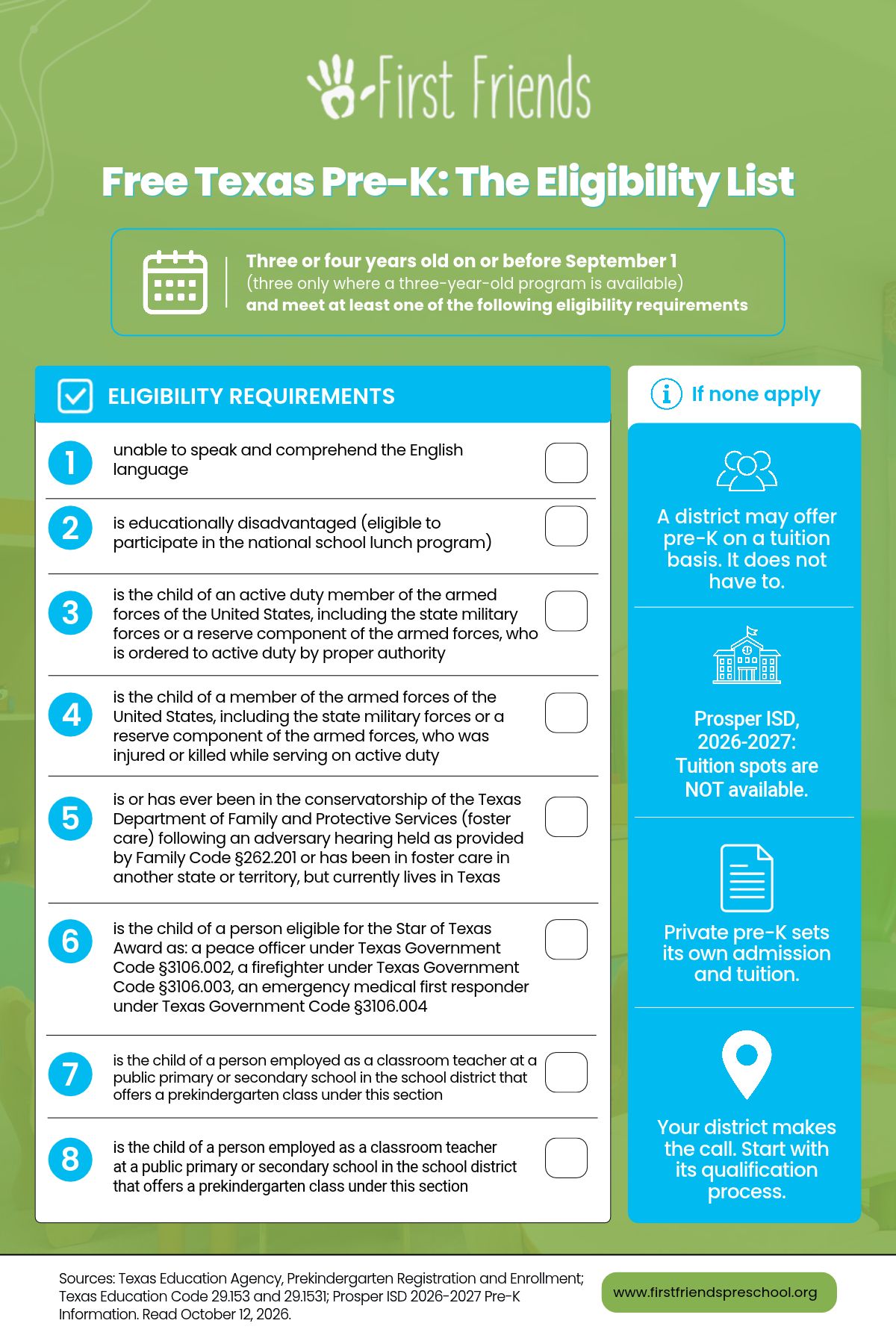
What If None of the Eight Apply to Your Child?
Then the free class is not available to your child, and what is left depends on what your district chooses to sell. Section 29.1531 of the Education Code, titled “Tuition-Supported and District-Financed Prekindergarten,” lets a district offer half-day and full-day classes “on a tuition basis” to children who are not eligible under Section 29.153. Districts may do this. They are not required to.
The same section attaches two conditions. The tuition rate may not be “higher than necessary to cover the added costs of providing the program.” And a district may offer tuition pre-K only after an official determination that no qualifying private prekindergarten providers are available to serve those students.
In Prosper, the answer for this school year is published. The district’s 2026-2027 pre-K information document, linked from its pre-K page, states plainly that “Tuition spots are NOT available.”
That leaves a family whose child meets none of the eight with two routes. One is a private program, which sets its own admission rules and its own price. The other is to wait for kindergarten.
Neither is a lesser choice.
What Prosper ISD Has Published for 2026-2027
Everything in this section comes from the district’s own material as we read it on October 12, 2026. District details change, so treat the Prosper ISD Pre-K Program page as the authority and this as a reading guide.
The district calls its program Blended Pre-K. Its page says applications for the 2026-2027 school year are open and gives a button labeled “Begin Pre-K Qualification Process.” The information document linked beside it adds the practical detail:
- The class is full-day, for children who turn four on or before September 1, 2026.
- The child must live within the Prosper ISD attendance zone.
- Transportation is not provided.
- The program follows the district calendar.
- The programs are located at Brenda Calhoun Early Childhood School. The document also lists Thomson Elementary and Judy Rucker Elementary, and says placement is decided case by case and based on space.
- Eligibility documents are uploaded inside the enrollment application.
Two lines in that document correct common assumptions. One says a Medicaid card alone is not an eligibility criterion. The other says there is no waiver of the age rule, using the example of a child with a September 3 birthday.
The district also explains the word “blended.” Its classes combine children who qualify under the state list with children served through early childhood special education. That second path is a separate determination, made by the district, and it sits outside this article.
A caution the district prints itself: an approved enrollment application “does not guarantee your child will or has qualified for PK.” Approval of the paperwork and qualification for the class are two different steps.
District lines do not follow city names
Brenda Calhoun Early Childhood School, the Prosper ISD campus named in that document, has a McKinney street address. That one fact says a lot about North Texas school boundaries.
Our families come from Prosper, Celina, McKinney, Frisco, Little Elm, and Aubrey, across Collin and Denton Counties. A family with a Celina or Frisco mailing address may be zoned to a different district than a neighbor a mile away, and each district runs its own qualification process against the same state list. The agency’s Find A School tool looks up programs by address or ZIP code, which is the reliable way to see whose process applies to you.
Three-Year-Olds Are in a Different Position
Public pre-K for three-year-olds is optional for districts. The agency says a child of three is eligible “only if the district operates a three-year-old prekindergarten program,” and the Prosper ISD document describes its class as for four-year-olds only.
One provision helps families who do get a three-year-old seat somewhere: under Section 29.153, a child who is eligible and enrolls at three stays eligible for the following school year.
For a Prosper three-year-old, that points toward private programs. Classes at our school begin at 18 months, and the threes attend two, three, or four days a week depending on the class. Starting at three years old, children must be potty trained to begin.
Public and Private Pre-K, Row by Row
| What you can check | District pre-K under Section 29.153 | Our private Pre-K |
|---|---|---|
| Who may enroll | Age by September 1 plus one of eight listed conditions | No eligibility list; seats go by class and space, and church membership is not required |
| Cost | No tuition, by statute | Monthly tuition, published |
| Ages | Four by September 1 in Prosper ISD for 2026-2027 | Classes from 18 months through Private Kindergarten |
| Length of day | Full-day for four-year-olds, by statute | 9 am to 2 pm |
| Days | Follows the district calendar | Monday through Thursday; Pre-K attends three or four days |
| Transportation | Not provided for Prosper ISD pre-K | Our site lists none |
| Class size | No more than 22 students under Education Code Section 25.112, with exceptions a district can request | Our site describes small classes and gives no number |
| Teacher requirements | Certification plus an added early childhood qualification, under Section 29.167 | Not set by the Education Code; put the question to any private program, ours included |
| Curriculum | Must include the state’s prekindergarten guidelines, under Section 29.167 | Bible-based curriculum, with weekly chapel from age three |
| Before and after care | Not covered in the district’s pre-K document; a question for the campus | Offered Monday through Thursday, run separately from the preschool |
Read down the left column and the district’s offer is strong. A child who meets one of the eight gets a full school day at no charge, in a class the state holds to its own program standards. If that describes your family, price it before you price us.
The agency’s own figures suggest many families never do. Its enrollment page estimates that about 57,000 eligible four-year-olds and about 225,000 eligible three-year-olds in Texas are not enrolled in public prekindergarten.
Length of day cuts both ways. The Calhoun campus posts school hours of 7:30 am to 2:50 pm, while the district’s pre-K document had not yet filled in pre-K hours for 2026-2027 when we read it. A four-day week with us is five hours a day, which comes to 20 hours.
Some families want the longer day. Others want a shorter week for a four-year-old and a Friday at home.
Our Pre-K Tuition, as Our Site Lists It
Private pre-K costs money, and a comparison that hides the number is not much use. These figures are copied from our tuition and fees as it stood on October 12, 2026.
| Schedule | Ages on our tuition page | Monthly tuition | Monthly security fee | Monthly total |
|---|---|---|---|---|
| 3 days | 2, 3 and 4 years by September 1 | $405 | $30 | $435 |
| 4 days | 3 and 4 years by September 1 | $465 | $40 | $505 |
The same page lists a one-time registration fee equal to one month of tuition, $405 or $465, due with the application and non-refundable. It also gives a 10% discount to the second and third child of a sibling enrolled.
Before and after school care is priced separately and is not on that page, so call the office for the figure instead of guessing from the table. Current openings by class are kept on our registration, which changes too often to quote here.
Timing on the private side, including the September 1 birthday line, is covered in our note on when private preschool seats open in Prosper.
Who Oversees Each Kind of Classroom?
Two different state agencies, under two different codes. That matters mostly because it changes where a parent looks things up.
A district pre-K class answers to the Texas Education Agency under the Education Code. The state’s child care licensing law, Chapter 42 of the Human Resources Code, exempts an educational facility accredited by the Texas Education Agency that operates primarily for educational purposes for prekindergarten and above. A classroom covered by that exemption needs no child care license, and its accountability runs through the district and the agency.
A private preschool that holds a child care license answers to Texas Health and Human Services Child Care Regulation. We are a state-licensed church preschool, and licensed operations appear on Search Texas Child Care, the state’s public lookup. The walkthrough we wrote on how to read a licensing record before a tour explains what the inspection history shows.
Not every private program is licensed. Some part-week programs are lawfully exempt, which is why we wrote about how Texas counts days of care when it decides who needs a permit.
Ten Minutes of Questions for Both Offices
Bring the same short list to each. The answers line up into a comparison faster than any brochure.
Questions for the district:
- Under which of the eight requirements would my child be assessed, and what documents do you need?
- Where would my child attend, and what are that campus’s pre-K hours this year?
- Is before or after care available at that campus, and who runs it?
- If my child does not qualify, is any tuition seat offered this year?
Questions for a private program, ours included:
- Do you hold a child care license, and under what name is it listed?
- Which day patterns are open for my child’s age right now?
- What is the full monthly cost, with every fee counted?
- What are the teacher’s qualifications in the room my child would join?
- Does your calendar track the local district’s? Ours closes on several Prosper ISD holidays, the October 12 and 13 break among them.
The same decision comes back a year later with kindergarten, and we cover that one in our guide to private kindergarten.
Get the Eligibility Answer First, Then Compare the Two
Start with the district, because its answer shapes everything after it. Read the eight requirements, open the qualification process for the district your address falls in, and let that office tell you where your child stands. If the answer is yes, visit the campus and weigh a free full day against whatever else you were considering.
If the answer is no, or if a shorter week in a faith-based classroom is what you wanted all along, come and see ours. Tours at First Friends Preschool run Monday through Thursday by appointment at 601 South Church Street in Prosper. Bring the question list above. We would rather you choose with both sets of facts in hand than choose us by default.
Frequently Asked Questions
What is the difference between public and private pre-K in Texas?
Public pre-K is free but limited by law to children who meet an age rule and at least one of eight listed requirements, verified by the district. Private pre-K is open to any family the program admits, charges tuition, and sets its own schedule and calendar.
Is public pre-K free for every child in Texas?
No. Texas Education Code Section 29.153 is titled “Free Prekindergarten for Certain Children.” A child must be three or four by September 1 and meet at least one of eight requirements listed by the Texas Education Agency. Districts verify eligibility before enrolling a child.
Does Prosper ISD offer tuition-based pre-K?
For 2026-2027, the district’s pre-K information document, read on October 12, 2026, states that tuition spots are not available. State law allows districts to sell tuition seats under set conditions, so check the district’s pre-K page each year for changes.
Can a three-year-old attend public pre-K in Prosper?
The Prosper ISD pre-K document for 2026-2027 describes a full-day class for children who are four on or before September 1, 2026. The Texas Education Agency says districts are not required to serve eligible three-year-olds, so availability at three varies by district.
How much does private pre-K cost at your school?
Our tuition page lists $405 a month for three days and $465 a month for four days, plus a monthly security fee of $30 or $40. The same page sets a one-time registration fee equal to one month of tuition, due with the application.