
Nobody tells you that the hardest part happens in a doorway. You have chosen the school, filled in the forms, labelled everything, and then your child wraps both arms around your leg and the whole plan feels like a mistake.
TL;DR
Crying at drop-off is not a sign that something has gone wrong, and paediatric guidance describes it as entirely normal behaviour and a sign of meaningful attachment. What matters more than whether it happens is how the goodbye is handled. The American Academy of Pediatrics advises quick goodbye rituals, consistency in the drop-off routine, giving your child full attention and then leaving promptly, and keeping the promise about when you will return. It also notes that by three years old most children clearly understand the effect their pleas have on adults, which is why returning to the room in response to crying tends to make the next morning harder rather than easier. The one thing almost every parent is tempted to do, slipping out while your child is distracted, is the thing early childhood guidance specifically warns against. Two weeks is a reasonable horizon to judge by, and the arc is rarely a straight line.
The Goodbye Is the Whole Thing
If you take one idea from this page, take this one.
The American Academy of Pediatrics puts the point plainly in its guidance on separation anxiety: keep the goodbye short and sweet, because if you linger, the transition time does too, and so will the anxiety. It recommends creating a quick goodbye ritual, whatever form that takes, and repeating it.
Consistency is the second half. The guidance suggests doing the same drop-off, with the same ritual, at the same time each day, so that unexpected factors are removed wherever possible. A routine, it notes, can diminish the heartache and let a child build trust in their own independence and in you at the same time.
The sequence it describes is worth reading as a sequence. Give your child your full attention, be loving, provide affection, and then say goodbye quickly despite the antics or the cries to stay. Attention first, then a clean exit. Not a drawn-out negotiation, and not a distracted handover either. The full guidance is on the AAP’s page on easing your child’s separation anxiety on HealthyChildren.org.
Why sneaking out backfires
It is the most tempting option in the building. Your child is absorbed in something, a teacher catches your eye, and you could just go.
Early childhood guidance is direct about this. ZERO TO THREE’s guidance on separation advises never leaving without saying goodbye, because sneaking away makes a child worry that you might leave at any time, which makes separation anxiety worse, and because they may stop trusting in your return. Their material is written about younger children, and the principle carries: a child who cannot predict when you disappear has to watch for it constantly.
The version we see in our own classrooms is a child who is fine at drop-off and then unsettled all morning, checking the door. A clear goodbye is harder for thirty seconds and easier for three hours.
What the Days Actually Look Like
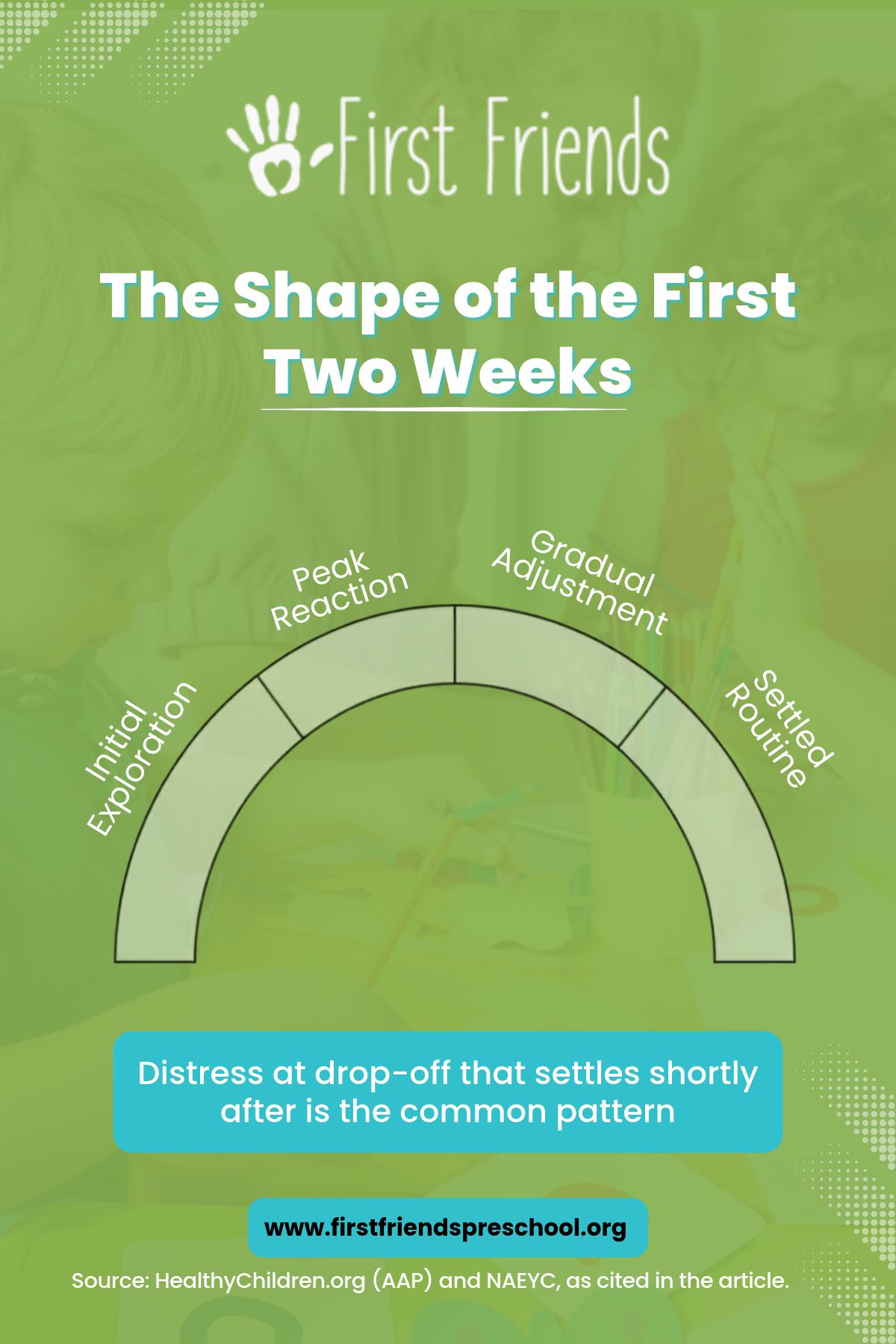
Parents ask for a timeline, so here is an honest description rather than a schedule. Every child is different, and the AAP notes that separation anxiety varies widely between children, so treat this as a shape rather than a forecast.
The first day is often the calmest, which surprises people. Everything is new, and novelty carries a child through. Some children walk in without looking back, and their parents are the ones who cry in the car.
Days two and three are frequently harder than day one. Now your child knows what is going to happen. The novelty is gone, and the pattern is visible, and that is usually when the doorway protest arrives.
The end of the first week tends to bring tiredness more than tears. A full morning of new people, new noise, and new rules is genuinely demanding, and it shows up at home as a short fuse in the late afternoon.
The second week is where the arc usually becomes visible. Not a smooth improvement, because there is often a wobble after a weekend at home, but a pattern you can see when you look back across ten days rather than at this morning.
That last point is the practical one. Judge by the fortnight, not by the morning you are standing in.
What We Do on Our Side of the Door
Half of this is happening after you leave, and it is fair to want to know what it consists of.
A child who is upset at drop-off is not left to settle alone. Our teachers move a distressed child into something with structure, because an activity with a beginning and an end gives a young child somewhere to put their attention. Familiarity matters more than variety in the first fortnight, so the daily rhythm stays deliberately predictable while everything else is new.
We watch for the child who is quiet rather than only the child who is loud. Loud distress is easy to spot and often resolves quickly. The child who says nothing and does not join in is the one worth paying attention to, and it is a common pattern in the first weeks.
And we tell you the truth about how it went. If your child settled four minutes after you left, you should hear that, because it is the single most useful piece of information for tomorrow morning. If they had a difficult morning, you should hear that too.
Pickup Matters More Than People Expect
Everything written about starting preschool concentrates on the morning, and the afternoon does at least as much work.
The AAP’s guidance frames returning as a trust-building act: your child becomes confident in their ability to be without you when you stick to your promise of return. That is a promise about timing, not just about turning up, and a young child measures it against the rhythm of the day rather than against a clock. Collected before lunch every day and then suddenly after lunch is a broken promise from where they are standing, even if you were never late.
So be boringly predictable at both ends. If pickup time has to change, say so at drop-off rather than letting it be discovered.
The other thing worth knowing is that a child who was completely settled all morning may fall apart the moment they see you. That is not a report on the day. It is the point at which holding it together stops being necessary, and it happens most in the children who coped best.
Ask the teacher how the morning actually went rather than reading the doorway. And expect very little detail from your child in the first fortnight. A three-year-old who has spent three hours managing new people has limited appetite for a debrief in the car park, and “I played” is a complete answer for now.
The Preparation That Actually Helps
Most of what makes the first two weeks easier happens before them, and the useful items are smaller than parents expect.
The National Association for the Education of Young Children publishes a list of practical suggestions for families whose child is starting preschool. Several are worth naming because they are easy to arrange and genuinely reduce the number of new things a child faces at once:
- Establish an early-to-bed and school-wake-up routine several weeks before school begins, so the schedule is not also new
- Find out about the toileting procedures at the school and talk them through, so your child knows what to expect
- Take part in any home visit or school visiting day, and if you cannot, call to arrange a visit and meet the teacher
- Arrange play dates with children who will be in the class, and ask the school for a list
- If your child has never been cared for by anyone else, start leaving them for short periods with friends or relatives, reinforcing that you will return
- Give your child something of yours to hold, such as a scarf, so they know you are coming back for it
- Read books about starting school and saying goodbye
The full list is in NAEYC’s 13 tips for starting preschool.
Notice what those have in common. Each one removes a single unfamiliar thing from a morning that is otherwise full of them. A child who already knows the building, the bathroom, and one other child is facing a much smaller change than a child meeting all of it at once.
Our calendar shows visiting days and start dates, which is the easiest way to build that preparation into the weeks beforehand.
Age Changes the Picture
Separation looks different depending on where your child is, and the AAP’s guidance breaks it down by stage.
|
Stage |
What the guidance describes |
|
Infants |
Separation anxiety develops after a child understands object permanence. Some show it as early as 4 to 5 months; most show it more strongly at around 9 months |
|
Toddlers |
Many skip it in infancy and begin at 15 or 18 months. Separations are harder when a child is hungry, tired, or unwell |
|
Preschoolers |
By age 3, most children clearly understand the effect their anxiety or pleas have on adults. That does not mean they are not genuinely stressed |
That third row is the one that changes a parent’s behaviour, and it deserves care. Understanding the effect of a plea is not the same as being manipulative, and the guidance is explicit that a child at this age is still stressed. What follows from it is practical rather than harsh: the AAP advises being consistent, not returning to the room based on a child’s plea, and not cancelling plans because of separation anxiety.
Keeping your promise is the other half of that. The guidance frames it as building trust and independence, because a child becomes confident in their ability to be without you when you reliably return when you said you would.
When to Raise It With Us
Almost everything above is ordinary. A few things are worth a conversation rather than waiting.
Raise it if the pattern is not moving at all across a full fortnight, if distress continues well into the day rather than easing after drop-off, if your child is not eating or sleeping at home in a way that is unusual for them, or if something has changed at home that we do not know about. A house move, a new baby, an illness in the family, a change in who does the school run: any of these can show up in a classroom, and knowing about it changes how we support your child.
We are not the right people to assess anything medical or developmental, and we will say so and suggest you speak to your paediatrician rather than offer an opinion we are not qualified to give. What we can do is tell you accurately what we are seeing, which is often the information that makes the next conversation useful.
If you are still weighing up settings, our comparison of preschool and daycare in Prosper and our notes on choosing the right preschool cover that decision, and when to enroll covers the timing.
Judge the First Weeks by the Fortnight
The morning you are dreading is not the measurement. Look at ten days together, and you will usually see the shape of it, and the shape is what tells you whether anything needs to change.
Come and see a morning in progress if that would help. First Friends Preschool welcomes visits before a start date; our programs page sets out what each day includes, and the registration page covers the practical steps.
Frequently Asked Questions
Is it normal for my child to cry at preschool drop-off?
Yes. Paediatric guidance describes separation anxiety as entirely normal behaviour and a sign of meaningful attachment, while also noting that it varies widely between children.
Should I stay until my child settles?
The AAP advises keeping goodbyes short, noting that if you linger, the transition time does too, and so does the anxiety. Give your full attention first, then say goodbye promptly.
Is it better to leave without saying goodbye?
No. Early childhood guidance advises against slipping away, because it makes a child worry you might leave at any moment and can undermine their trust that you will come back.
How long does the adjustment usually take?
There is no fixed period, and no source publishes one, which is why we suggest judging by a fortnight rather than by a single morning. Expect a wobble after weekends rather than a straight line.
What if my child is quiet rather than upset?
Tell us. A quiet child who is not joining in is easy to overlook, and it is a pattern we specifically watch for in the first weeks.