

TL;DR
Here is how to check a daycare licensing record in Texas. Go to Search Texas Child Care, the public site run by HHSC Child Care Regulation, and search by operation name, address or ZIP code. Open the operation’s details page, then open the full compliance history.
You will see five years of inspections, self-reported incidents, complaints and any deficiencies cited, each tied to a minimum standard carrying a weight of high, medium high, medium, medium low or low. A citation on its own is not proof of a bad program. Patterns, repeats and high-weight items are what matter, and the record is most useful as a list of questions to ask on the tour.
Where the Record Actually Lives
The site is Search Texas Child Care, run by the HHSC Child Care Regulation department. The shortcut address txchildcaresearch.org now forwards to the live tool at Search Texas Child Care, so both get you to the same place.
Pick “Child Day Care” rather than 24-hour residential care.
Then search by location or by provider. A ZIP code search around 75078 pulls the operations closest to you; a name search is faster if you already have a shortlist from a neighborhood group. The state’s own Search Texas Child Care user guide, published by HHSC and revised March 2026, walks through the filters and the comparison tool, which lets you put up to four operations side by side.
Once you open an operation, the details page carries the basics: ages served, hours, capacity, permit status, and whether any conditions sit on the permit. Below that is a compliance summary, and below that a link to the full Inspection and Compliance History page.
That link is the whole point of the visit.
Sixty Months, and What Falls Off It
The public record holds five years. Anything older has already rolled off, which cuts both ways: a program that had a rough stretch six years ago reads clean today, and a program that opened last spring has almost nothing to show you. Ask how long the operation has held its current permit before you read anything into an empty page.
What Does a Deficiency Actually Mean?
A deficiency is any failure to comply with a Child Care Regulation statute, administrative rule or minimum standard. That is the state’s own definition, and the range it covers is enormous. It includes a missing signature on a training file, a posting that fell off the wall, a diaper-changing step done out of order, and a supervision lapse.
All four are deficiencies. They are not remotely the same event.
Two things about the timing are worth knowing. A deficiency is posted to the public record only after the operation has had the opportunity to dispute it, so what you are reading has already survived a challenge window. And the record tells you how the operation corrected each one, which is often more informative than the citation itself.
The state also tells parents, in writing, to weigh these rather than count them. Its guidance page on CCR reports, inspections and enforcement actions asks four questions: which standard was cited and what weight it carried, whether deficiencies have repeated in the last two years, how long the operation took to come back into compliance, and how often it gets inspected. Those four questions are a better reading method than anything we could invent.
The Five Weights Are the Whole Story
Every minimum standard that can be cited carries a weight based on the risk a violation presents to children. Definitions and headings are not weighted, because you cannot violate a definition.
|
Weight |
How to read it |
|
High |
Greatest risk to children if violated. Background check requirements sit here, and a high-weight deficiency can draw an administrative penalty, which is a fine |
|
Medium high |
Serious, and worth asking about directly |
|
Medium |
Common ground for supervision, health and record-keeping items |
|
Medium low |
Lower risk, often procedural |
|
Low |
Least risk of the weighted standards |
The weights are published at the end of each standard or subsection in the minimum standards themselves, so a director can look up any citation on their record and read the exact rule with you.
Ask them to. It takes a minute.
One honest caution about the high band. A high weight describes the risk the standard is meant to prevent, not the outcome of the particular incident. A background check submitted late is a high-weight problem because of what an unscreened adult could do, and the state treats it that way whether or not anything happened. Reading “high” as “a child was hurt here” will lead you badly wrong.
What the Numbers Look Like Across Prosper
We pulled the state’s own open dataset on 12 August 2026 to see what a normal record looks like in one town, because that context is what parents are missing. Prosper has 42 permitted child day care operations in the HHSC daycare and residential operations data, which HHSC last refreshed on 11 August 2026: 31 licensed centers, four licensed child care homes, three registered child care homes, and four listed family homes.
Across those 31 licensed centers, the state records 404 inspections and 455 deficiencies. Only three of the 31 show a completely clean sheet. Twenty-five of them carry at least one high-weight citation somewhere in the window, and none of the 42 operations in town currently sits on a corrective action or an adverse action, per the same state dataset.
Read that second paragraph again slowly, because it reframes the whole exercise. If a single citation disqualified a program, a Prosper family would be choosing between three centers. Nobody who has actually toured this town believes that is the real picture.
The spread inside those 455 citations matters more than the total. Medium high is the largest band at 194, then medium at 131, then high at 112, with medium low and low almost absent between them. That shape is what a rule set weighted toward risk produces when it is applied by inspectors visiting every licensed operation at least once a year: the trivial stuff rarely gets written up, and the middle bands carry the everyday supervision, health, and record-keeping items.
The distribution also explains why raw counts mislead. A larger center running two classrooms of infants is evaluated against more standards, on more visits, than a small program serving four-year-olds four mornings a week, so it accumulates more chances to be cited.
Comparing a big center’s count to a small one’s without looking at inspection volume is comparing two different sample sizes.
One more figure from that same pull is worth carrying into a tour. Prosper operations logged 54 self-reported incidents and 71 public reports over the window. Those are separate columns for a reason, and confusing them is the most common way parents misread a page.
Is a Citation Ever a Real Red Flag?
Yes, and it has a shape.
A pattern of repeated deficiencies against the same standard, high-weight citations that recur, a long gap between the citation and the correction, or an active corrective action all point to something structural rather than a bad Tuesday. The state escalates in that order too.
HHSC imposes a corrective action when an operation has a pattern of deficiencies, or one single serious deficiency that endangers the health and safety of children, and it inspects more often while that plan runs. When a corrective action does not bring the risk down, HHSC moves to an adverse action, which can mean permanent conditions on the permit or closing the operation. Both flags appear in the Penalties and Actions section of the public record, and if a corrective action is active, the plan itself is posted for you to read.
So the hierarchy is straightforward.
One medium-weight paperwork citation, corrected in a week, three years ago, tells you almost nothing. The same standard cited four times in two years tells you the operation has a habit it has not fixed, and the second and third repeats are the ones to raise, since anyone can miss a rule once.
A citation that took months to close tells you something about how the office runs, separate from what happened in the classroom. An active corrective action tells you the state has already reached the same conclusion you are reaching, has written a plan, and is visiting more often until it closes. That is the one item on the page that deserves a direct conversation before you enroll.
Reading One Inspection Page Without Spiralling
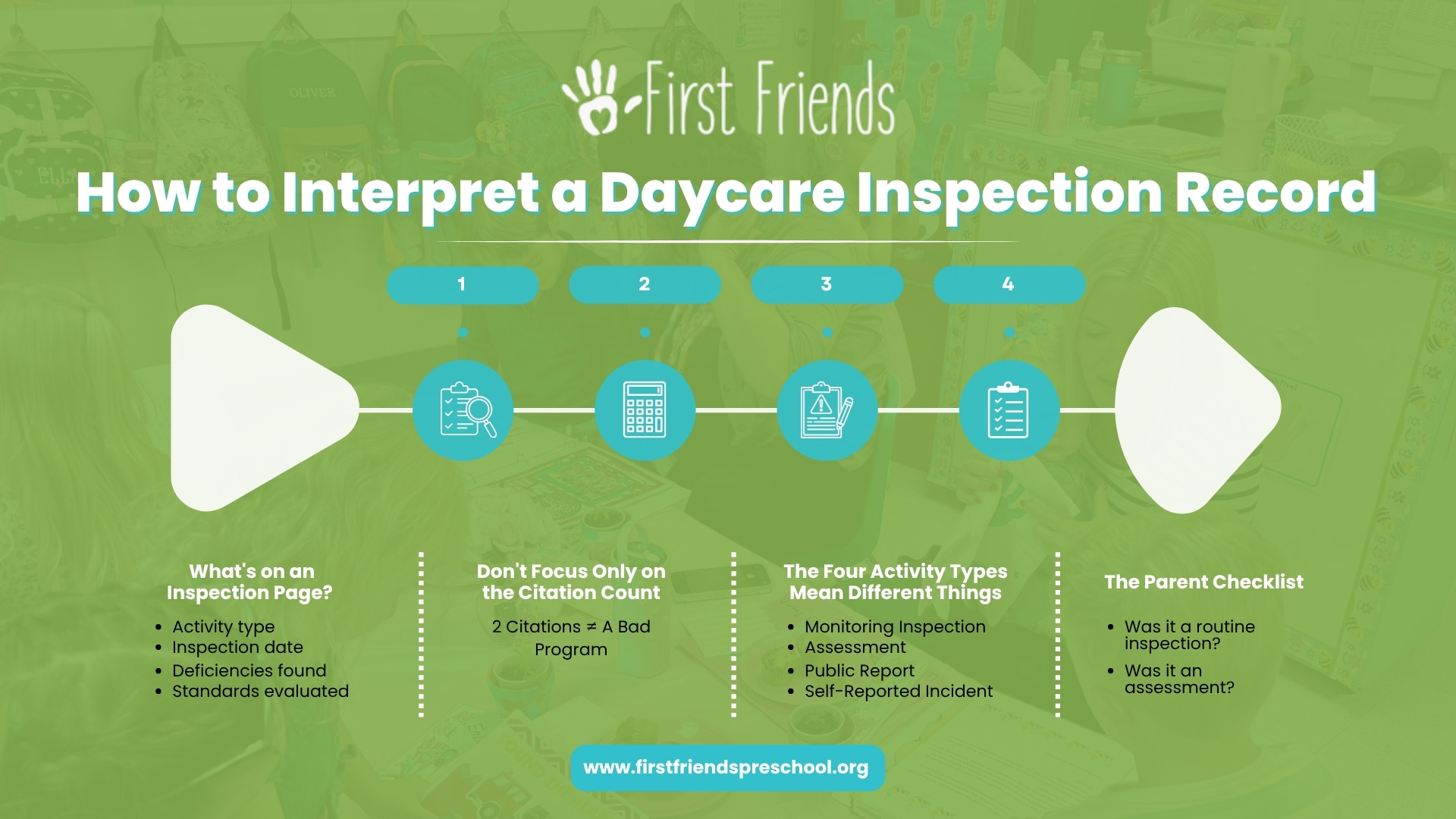
Open a single activity, and the page shows the activity type, the date, the deficiencies found, and something most parents miss: the number of standards found compliant against the number of standards evaluated, broken out by subchapter. An inspection is a sweep across dozens of requirements, and the page shows you the denominator.
Two citations out of a long list of evaluated standards reads very differently once you can see the list.
Activity types matter as much as counts. The record separates inspections, assessments, reports, and self-reported incidents, and they mean different things:
- A monitoring inspection is a routine unannounced on-site visit. Licensed operations get at least one per year, more often if compliance has been shaky.
- An assessment is a citation issued after reviewing paperwork or other materials, without an on-site visit.
- A report is information from the public, including from a parent, that CCR investigated.
- A self-report is the operation telling the state about a serious incident, which it is required to do.
That last one is the most misread line on the whole record, every time. A self-report exists because the program followed the rule and called it in. An operation with several self-reports and prompt corrections is showing you a functioning reporting culture. Judging a program for self-reporting punishes exactly the behaviour the system is built on.
Permit Type Changes What the Record Can Tell You
Not every operation in a search result is inspected on the same schedule, and the differences are large enough to change how you read a short record.
|
Permit type |
Who it covers |
Routine inspection |
|
Licensed child care center |
Seven or more children aged 13 or younger, outside the permit holder’s home |
At least one unannounced monitoring inspection per year |
|
Licensed child care home |
Seven to 12 children, in the caregiver’s home |
At least one unannounced inspection per year |
|
Registered child care home |
Up to six unrelated children, in the caregiver’s home |
At least one unannounced inspection every one to two years |
|
Listed family home |
Up to three unrelated children, in the caregiver’s home |
Not routinely inspected, only on a report |
Those definitions come from HHSC’s own explanation of the types of child care operations. The four listed family homes in Prosper show zero inspections in the state data, which is not a criticism of any of them: it is what the permit type means. An empty record is only reassuring when the permit type comes with regular inspections in the first place.
You may also see a Texas Rising Star rating on some profiles and not others. That is a quality certification tied to providers serving families who receive child care scholarships, and the state’s family guide to quality certifications on childcare.texas.gov describes the two, three, and four star levels as going beyond the basic rules. Plenty of strong private programs never appear in it, because they do not take those scholarships. Absence of a star is not a mark against a program.
Rights You Already Have Before the Tour
Texas rewrote the parent rights rules for child care centers effective 19 August 2024, and most parents have never read them. Under the parent rights section of Chapter 746, published by HHSC in its August 2024 rule changes document, a parent of a child in care has the right to enter and examine the center during operating hours without advance notice, to review the center’s publicly accessible records, to receive HHSC’s inspection reports for the center, to be told how to reach the center’s compliance history online, to review staff training records and in-house training curriculum on request, and to be free from retaliation for using any of those rights.
Two of those are directly useful during a search.
A center is expected to hand you the inspection reports or point you to where they are posted, so you should never have to argue for them, and a director who hesitates has told you something. Unannounced access, once your child is enrolled, is the daily version of everything the compliance record measures once a year, which is why the 2024 rewrite added it in plain language.
Nobody can promise you a perfect classroom, and no record can. What the rules give you is the standing ability to look, on an ordinary Tuesday, without warning anyone first. Use it in the first month, not the first crisis.
The rules also require centers to have written operational policies covering release of children, illness exclusion, medication, medical emergencies, safe sleep for infants, suspension and expulsion, and how parents are notified of policy changes. Ask for the policy document. Reading it next to the compliance record tells you whether the written system and the inspected reality match.
Turning the Record Into Better Tour Questions
The point is not to arrive with a printout and an accusation.
It is to spend your tour hour on the things that actually differ between programs.
Take the two or three citations that stand out, look up each standard, and ask what changed afterward. Directors who run a tight program tend to answer these easily, because they lived through the correction and usually improved a system because of it. A vague answer to a specific, dated question is itself information.
A few worth asking in Prosper right now, with school back in session since Prosper ISD started on 11 August:
- Which standard was this, and what does the rule actually require?
- What changed in your routine after it, and who checks that it stays changed?
- How many staff have turned over in the last year, and how is training tracked?
- Who is in the room at the transition times, arrival, nap, and pickup?
- What triggers a call to me, and what gets reported to the state?
Then match the answers against the day itself. Our preschool Prosper TX programs run half days on a school-year calendar, which is a different rhythm from a full-day center, and the difference between a preschool and a daycare shapes which questions carry weight for your family. Families weighing the year after preschool often ask us what a private kindergarten is at the same visit.
When to do the search
Do it before you book. Twenty minutes of reading changes the questions you ask, and a tour where you already know the record is worth roughly double one where you do not. If you are timing a fall start, our guide to enrollment timing in Prosper explains why the winter window matters more here than parents expect, and the tuition and registration pages on our site cover the paperwork side.
Bring the Record With You to the Tour
Print the compliance history, or keep it open on your phone. Either works.
Walk in with two or three specific questions drawn from it and one about the daily routine you care most about, then watch how the answers land. You are looking for a director who knows their own record, can find the standard, and tells you what they changed. That combination is a stronger signal than a spotless five years, because almost nobody has a spotless five years.
We would rather you did this before you visit us. Come with the questions, ask them in the classroom, and hold the answers against what you see. If you would like to walk through ours in person, First Friends Preschool schedules tours by appointment, and you can reach us.
Frequently Asked Questions
How do I check a daycare licensing record in Texas?
Search the operation by name, address, or ZIP code on Search Texas Child Care, the public HHSC site, then open its details page and the full compliance history. You will see five years of inspections, deficiencies, penalties and any corrective or adverse actions.
Does a deficiency mean the daycare is unsafe?
No. A deficiency is any failure to meet a statute, rule or minimum standard, which covers everything from a paperwork lapse to a supervision problem. The state asks parents to look at the standard’s weight, whether it was repeated, and how quickly it was corrected.
How often are Texas child care centers inspected?
Licensed centers receive at least one unannounced monitoring inspection each year, and more frequent visits if compliance has been a problem. Registered child care homes are inspected at least once every one to two years. Listed family homes are inspected only in response to a report.
Why does one preschool have no record at all?
Usually the permit type or the age of the operation. Listed family homes are not routinely inspected, and any operation permitted recently has little history yet. The public site shows sixty months, so older activity has already rolled off.
Can I ask a preschool for its inspection reports directly?
Yes. Texas parent rights for child care centers include receiving HHSC’s inspection reports and being told how to reach the compliance history online. Centers may satisfy this by posting the reports on site and pointing you to the posting.