
Most children are ready for pre-k when they can separate from you without a long meltdown, follow a simple two-step direction, play alongside other kids, and handle basic self-care like washing hands or putting on a coat. Age matters too. Many pre-k programs ask that a child be 4 by a set cutoff date, often September 1. But age alone is not the whole picture. The real markers are emotional and social: can your child manage small frustrations, ask for help, sit for a short story, and bounce back after a goodbye? If most of those sound like your child, they are likely ready. If a few are missing, that is normal at this stage, and the gaps usually close fast with the right support. Below, we walk through the exact signs to look for and what to do if your child needs a little more time.
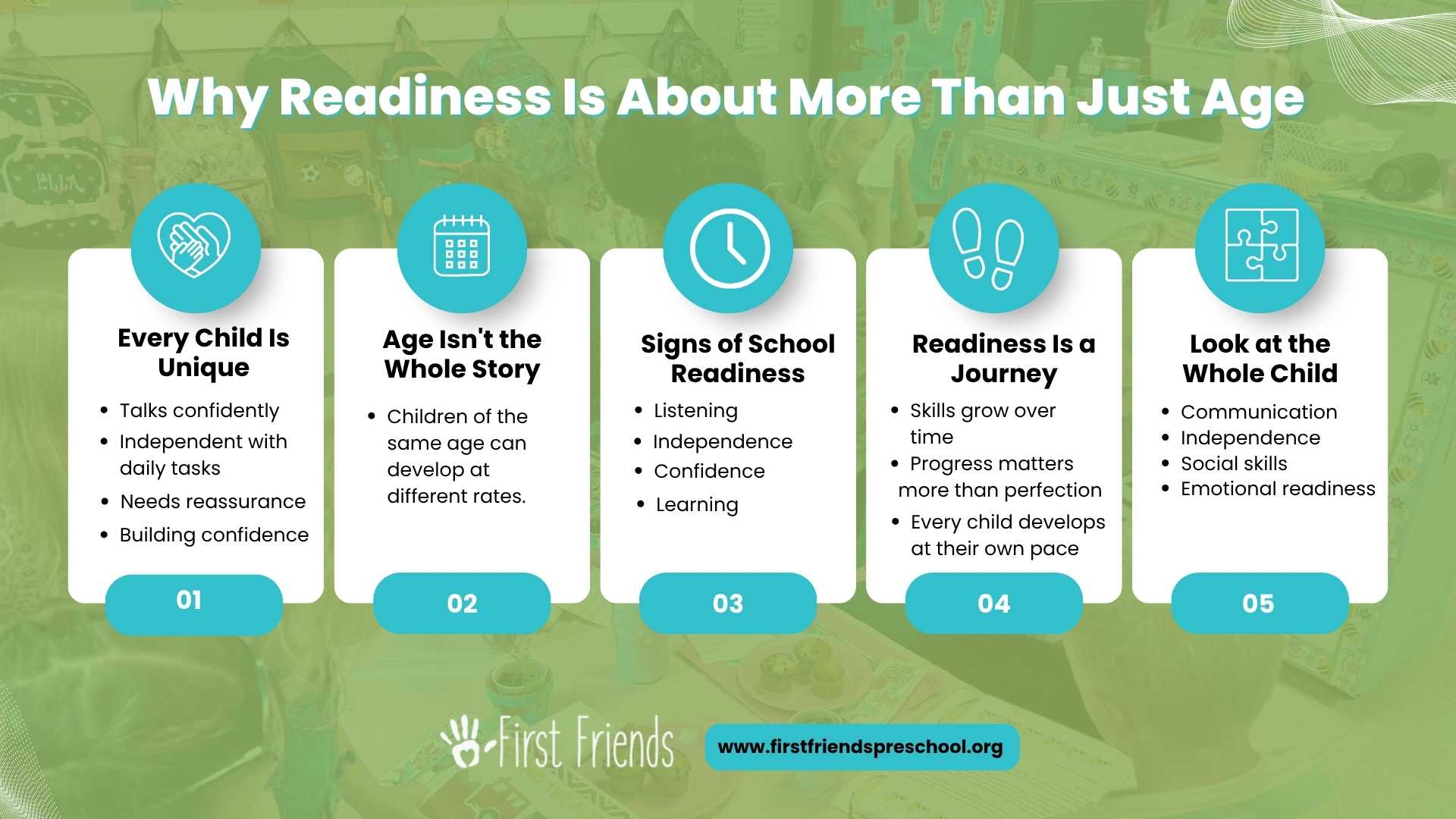
Why Readiness Is About More Than Just Age
Parents in towns like Prosper, McKinney, and Frisco ask us this question every enrollment season, and the honest answer is that a birthday on the calendar tells you less than a morning of watching your child play. Two kids can both turn 4 in the same month and land in very different places. One chats with strangers and zips their own jacket. The other still cries at drop-off and needs help with the bathroom. Both can thrive in a good program, but knowing where your child stands helps you choose the right fit and set them up to feel proud instead of overwhelmed.
When you ask yourself “is my child ready for pre-k,” you are really asking whether your child can handle the rhythm of a classroom day. That means following a routine, sharing attention with a teacher, and getting through a few hours without you. None of these skills need to be perfect. They just need to be growing. Readiness is a direction, not a finish line.
It also helps to remember that the calendar cutoff exists for staffing and grouping reasons, not as a science of child development. A program that takes 4-year-olds is building a room around the typical 4-year-old, but no child is the average. Your child might be ahead on language and behind on bathroom independence, or the reverse. Both patterns are common, and neither one decides the answer on its own. The goal is to look at the whole child and ask whether the gap between where they are and where the room expects them to be is small enough to close with practice and patience.
What Are the Main Pre-K Readiness Signs?
The clearest pre-k readiness signs fall into four buckets: separation, communication, independence, and basic focus. If your child shows most of these, they are in good shape for a classroom.
Here is a quick checklist you can run through at home:
- Can say goodbye to you and recover within a few minutes
- Follows a simple instruction like “put your shoes by the door”
- Uses words to ask for help or say what they need
- Plays near or with other children, even if sharing is still hard
- Handles bathroom trips with little help
- Can sit through a short book or activity, around 5 to 10 minutes
- Shows curiosity about letters, numbers, colors, or how things work
- Manages small disappointments without falling apart every time
You do not need every box checked. A child who hits most of them is ready to grow into the rest. If only two or three feel true today, that is useful information, not a red flag. Kids develop in bursts, and the months right before a program starts often bring big jumps.
A simple way to read your checklist: count how many items feel mostly true on an ordinary day, not a perfect one. Six or more out of eight, and your child is very likely ready to start and grow. Four or five, and they are close, so target the missing pieces over the next few weeks. Three or fewer, and it is worth a longer conversation with a teacher or your pediatrician before you decide. Watch your child across a few different days too, since a single rough afternoon after a missed nap tells you almost nothing about true readiness.
Social and Emotional Signs to Watch For
The strongest predictor of a smooth start is emotional steadiness, not academic skill. A child who can calm down after being upset and reconnect with an adult will do better than a child who already knows their alphabet but melts down when plans change.
Watch for these social and emotional markers:
Separation without lasting distress. Tears at goodbye are normal, even for ready kids. The sign you want is recovery. Within a few minutes, can your child shift into play? If a trusted adult can redirect them and the storm passes, that is a strong yes.
Beginning to share and take turns. True sharing is hard at this age, so do not expect generosity on demand. Look instead for the early version: your child can wait a short turn, hand over a toy when guided, and not treat every conflict as a crisis.
Asking for help. A child who walks up and says “I can’t reach” or “I need help” has a skill that carries them through a whole school day. It means they will tell a teacher when something is wrong instead of shutting down.
Managing frustration. No 4-year-old handles every letdown gracefully. The question is whether your child has any tools at all. Do they sometimes take a breath, ask for a hug, or move on after a moment? Those small wins matter more than perfect behavior.
Curiosity about other kids. Children who notice peers, watch what they are building, and try to join in are showing social readiness. Even shy kids who hang back and observe are doing important work. Wanting to be near other children is the seed of friendship.
If your child shows most of these even some of the time, they have the emotional base a classroom needs. One sign parents often miss is how a child handles transitions during the day. The move from play to cleanup, or from snack to circle time, is where many 4-year-olds wobble. A child who can stop one activity and start another with a gentle reminder, even if they grumble, is showing real readiness. You can practice this at home by giving a two-minute warning before you switch tasks, which is exactly what a good classroom does.
Early Skills That Help in a Pre-K Classroom
Beyond feelings and friendships, a handful of practical skills make the day go smoother. None of these are about being “smart.” They are about being able to take part.
Self-care basics. Using the bathroom with little help, washing hands, putting on a coat, and managing a lunch or snack all reduce a child’s stress in a group setting. The more a child can do alone, the more confident they feel.
Listening and following directions. Can your child follow a two-step request like “pick up the blocks and bring me your cup”? Classrooms run on simple directions, and a child who can track them feels successful right away.
Talking in sentences. Your child does not need perfect grammar, but being able to string a few words together to be understood by adults outside the family helps a lot. It lets teachers meet their needs and helps them join group talk.
Fine motor warm-ups. Holding a crayon, turning book pages, stacking blocks, and using safety scissors all build the hand strength that later writing depends on. You do not need worksheets. Play does this work.
Early interest in letters and numbers. Notice if your child points out signs, counts steps, or sings the alphabet. This budding interest is the foundation for the academic side of kindergarten readiness, and a good program builds on it gently rather than rushing it.
Think of these as helpers, not gatekeepers. A child can be fully ready emotionally and still be working on scissors. The program is there to teach the rest. It is worth naming the few skills that make the biggest daily difference, since some matter more than others.
Bathroom independence tops the list, because accidents are stressful for a child and time-consuming for a teacher. Being understood by an unfamiliar adult comes next, because a child who cannot make their needs known gets frustrated fast. After those two, the rest can be coached in the room over the first month. If you only have energy to practice two things before the first day, pick the bathroom and clear speech.
What If My Child Isn't Quite Ready Yet?
If your child is missing several markers, the best move is not to panic and not to push. Give them targeted practice, talk with people who know your child, and revisit the question in a few weeks. Development at this preschool age moves fast, and a gap in spring can close by late summer.
Here is what actually helps:
Practice the goodbye. Build short separations into your week. Leave your child with a grandparent or a trusted friend for an hour, then build up. Always say a clear goodbye and come back when you say you will. This teaches the core lesson: you always return.
Set up playdates. Time with other kids builds sharing, turn-taking, and the comfort of being in a group. A few hours of unstructured play with peers does more for social readiness than any flashcard.
Build independence at home. Let your child pour their own water, carry their plate, choose between two outfits, and clean up their toys. Each small job grows the confidence they will carry into a classroom.
Read together every day. Reading builds the sit-and-listen muscle, grows vocabulary, and feeds curiosity about letters. Even ten minutes a day adds up.
Talk to a teacher or pediatrician. If you have real concerns, like a child who rarely makes eye contact, has very few words, or seems overwhelmed by everyday noise and change, a conversation with your pediatrician is a smart step. Most of the time you will get reassurance. Sometimes you will get early support that makes everything easier.
It is also fine to wait a year. Some children, especially those with summer birthdays, simply do better with extra time. Choosing to wait is not falling behind.
It is matching the start to the child, which is exactly what a thoughtful parent does. If you do decide to wait, make the extra months count rather than treating them as idle time. Sign up for a weekly playgroup, build a steady morning routine at home, and slowly stretch the time your child spends away from you. Children who arrive a year later with that kind of practice often walk in as the steady ones the younger kids look up to.
How a Good Program Supports the Transition
A strong pre-k program meets children where they are, so your child does not have to arrive “finished.” The right classroom expects that some kids cry at drop-off, some are still mastering the bathroom, and some need help joining play. That is the job.
Look for programs that ease the move in real ways. Gentle goodbyes and a predictable morning routine help anxious kids settle. A warm, steady teacher who greets each child by name builds trust fast. Small group sizes mean your child gets noticed and supported, not lost. A daily rhythm of play, story, snack, and outdoor time gives children the structure that makes them feel safe.
Good programs also teach the very skills on your readiness checklist. They coach sharing in the moment, walk kids through frustration, build self-care habits, and weave letters and numbers into play instead of drilling them. Strong communication with you matters too, so you hear how drop-off went and what your child is working on. When home and school send the same message, children settle in faster.
When you tour a program, ask a few pointed questions that reveal how the room really runs. How do you handle a child who cries at drop-off? What does a typical morning look like minute by minute? How will I hear about my child’s day?
How many children does each teacher care for? The answers tell you whether the program has a real plan for the wobbly first weeks or simply hopes children sort themselves out. Watch the room too. Are the children busy and at ease, and do the teachers kneel to talk at a child’s level? Those small signals say more than any brochure.
Serving families across Prosper, Celina, McKinney, Frisco, Little Elm, and Aubrey, we see kids who arrive unsure and, within a few weeks, walk in waving goodbye on their own. The change rarely comes from a child suddenly being ready for everything. It comes from a patient classroom that grows readiness day by day. So if your child shows most of the signs above, trust that the rest will come with the right support around them.
A Few Honest Words Before You Decide
Readiness is rarely all or nothing, and very few children check every box on day one. Look for the direction your child is moving, lean into the social and emotional signs most of all, and give a little practice where it is needed. When you are ready to see how the right environment can carry your child the rest of the way, take a look at our pre-k program at First Friends Preschool and picture your child settling in. Most kids surprise their parents with how quickly they bloom.
Frequently Asked Questions
What age should my child start pre-k?
Most pre-k programs serve children who are 4 years old, and many ask that a child turn 4 by a cutoff date such as September 1. Age is a starting point, not the full answer. A child who is 4 but still struggles with separation or basic self-care may need more support, while a confident child may be ready right at the cutoff. Look at the readiness signs alongside the birthday.
Does my child need to know letters and numbers before pre-k?
No. Children do not need to read, write, or count fluently before pre-k. A budding interest in letters, numbers, and colors is helpful, but the program is designed to teach these skills through play. Emotional and social readiness, like handling goodbyes and following simple directions, matters more than academic knowledge at this stage.
Is it bad to wait a year before starting pre-k?
Not at all. Some children, especially those with summer birthdays or who need more time with separation and independence, do better starting a year later. Waiting is a thoughtful choice that matches the start to your child rather than a setback. Many parents find an extra year builds confidence that pays off in kindergarten.
My child cries at drop-off. Are they not ready?
Tears at goodbye are common even for fully ready children. The sign to watch is recovery. If your child can settle into play within a few minutes after you leave, that is a good signal. A caring classroom with a predictable routine helps anxious kids adjust, often within the first couple of weeks.
What can I do at home to help my child get ready?
Practice short goodbyes, set up playdates with other kids, read together daily, and let your child handle small jobs like pouring water or putting on their coat. These everyday habits build the separation, social, and independence skills that make the first weeks of pre-k go smoothly. Talk to your pediatrician if you have specific concerns.