
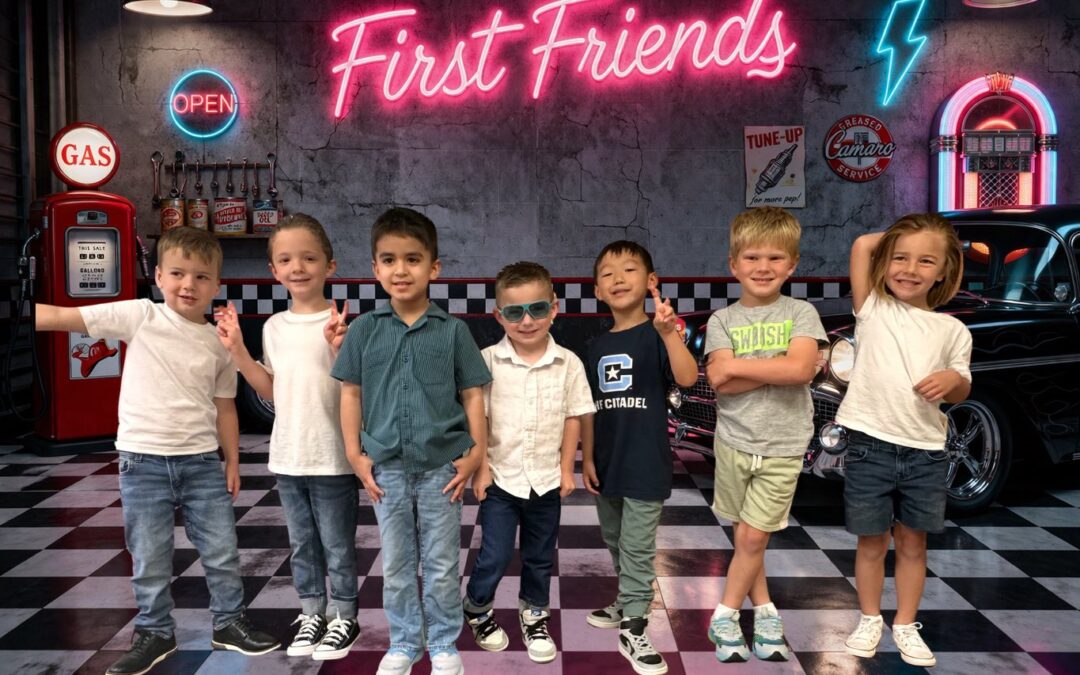
Most toddlers start showing they’re ready for a preschool setting somewhere between 18 months and 2 years old. The signs are usually simple. They can handle short stretches away from a parent, they follow a basic one-step direction like “go get your cup,” and they notice and show interest in other children nearby.
If you’ve been wondering whether your 18-month-old is ready for that first classroom experience, you’re in good company. It’s one of the questions parents ask us most. First Friends Preschool in Prosper recently added a Toddlers class for children 18 months and up, so we put together this guide to help you read your own child’s signals and understand what a quality toddler care program actually does for kids this age.
What Happens Developmentally at 18 Months?
Eighteen months is a season of fast change. In a short window, most toddlers go from cautious walkers to confident movers who run, climb, and rarely sit still. Language starts to take off too. Many kids this age use a handful of words, point at things they want, and understand far more than they can say.
You’ll also see the early roots of social behavior. Toddlers at this stage tend to play near other children rather than with them. That’s called parallel play, and it’s completely normal. Sitting beside a peer and watching how they stack blocks is how a toddler begins to learn about cooperation.
So is 18 months too early for preschool? Not at all, as long as the program fits the age. A good toddler learning program for this stage isn’t about worksheets or sitting still for long stretches. It’s short, gentle, and built around play, movement, music, and routine. That kind of setting supports the growth that’s already happening instead of rushing a child past it.
7 Signs Your Toddler Is Ready for a Preschool Environment
Every child develops on their own timeline, so treat this as a readiness checklist rather than a pass-fail test. Most toddlers won’t tick every box, and that’s perfectly fine.
- They can separate from you for short periods. A few tears at drop-off are normal. What matters is whether your child settles and re-engages once you’ve gone.
- They follow simple directions. “Bring me the ball” or “let’s wash hands” gets a response, even if it takes a gentle reminder.
- They show interest in other kids. They watch, point, or wander toward other children instead of tuning them out.
- They communicate in some way. Words, gestures, pointing, or babbling with clear intent all count. Speech doesn’t have to be advanced.
- They can handle a basic routine. They’re used to a loose daily rhythm of eating, playing, and resting.
- They’re curious and like to explore. They reach for new toys, open cabinets, and want to see how things work.
- They’re starting to do things on their own. Trying to feed themselves, pull off a sock, or stack cups all point to growing independence.
If your toddler shows even a few of these, they’re likely ready to start. The rest tends to develop quickly once a child is in a supportive group setting.
Benefits of Early Socialization
Social development for toddlers happens through repetition and gentle guidance, not lectures. When a toddler spends regular time around peers, they get daily practice at the skills that are hard to teach at home: waiting for a turn, sharing a toy, reading another child’s face, and using words instead of grabbing.
A toddler care program gives kids a safe place to run into these lessons over and over. A teacher steps in to model how to ask for a toy or comfort a friend who’s upset. Over time, parallel play turns into real interaction. Small class sizes help a lot here, because a toddler can’t build relationships in a crowd. At First Friends, classes stay small on purpose so every child gets attention and is known by name.
How Toddler Programs Build Independence
One of the quieter benefits of toddler preschool is confidence. When an 18-month-old realizes they can hang up their own bag, wash their hands, pick an activity, and help clean up, something clicks. They start to see themselves as capable.
Short, predictable days build that sense of security. A toddler learns that mom or dad always comes back, that the schedule looks the same each visit, and that the classroom is a safe place to try things. That early trust makes later transitions smoother, whether it’s moving up to a 2 to 3-year-old class or eventually starting Pre-K. If you’re curious about those next steps, our private kindergarten post walks through what comes after the early years.
What Parents Should Look for in a Toddler Care Program
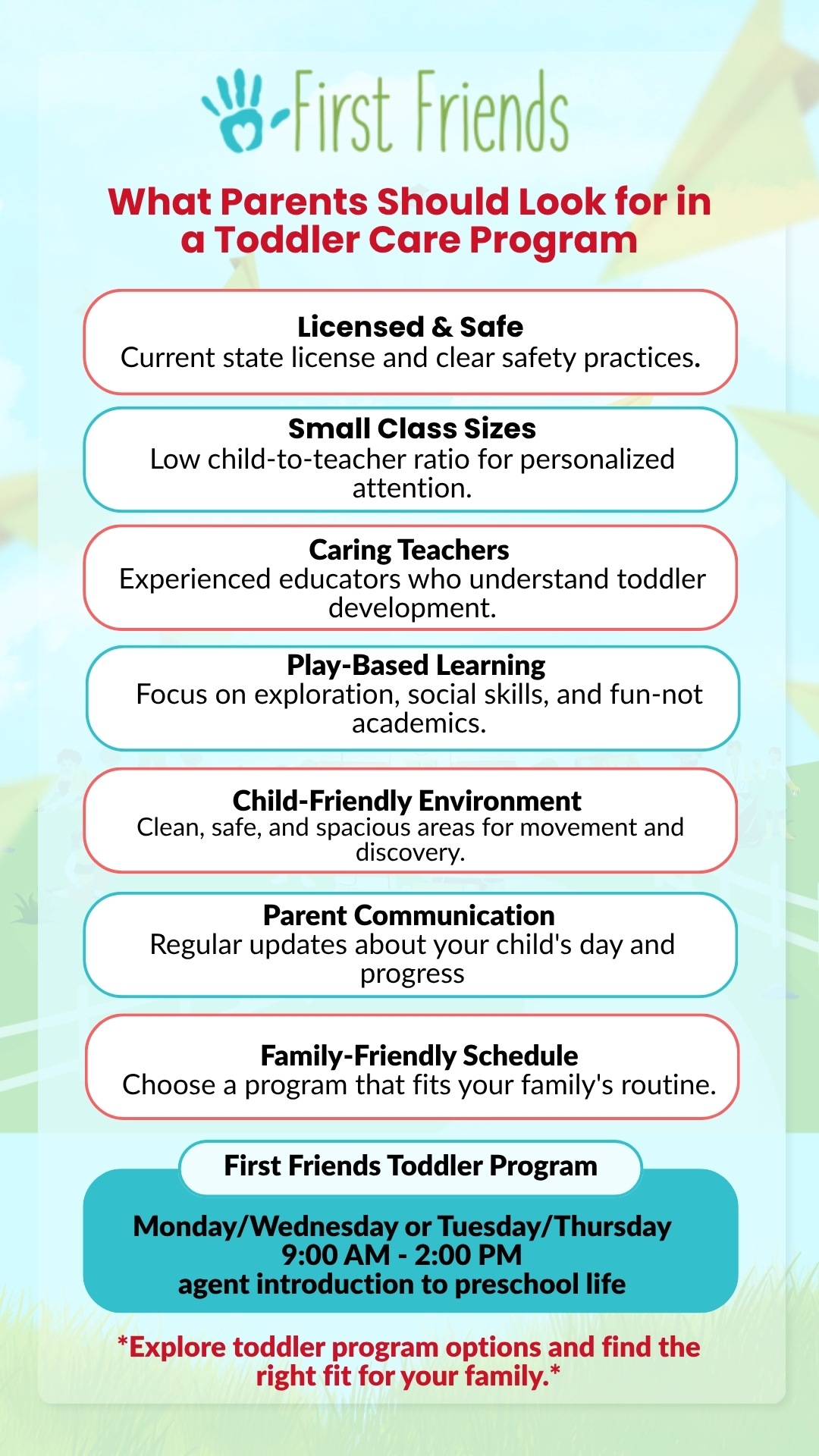
Not every program is the same. When you are comparing private kindergartens near you, keep these points in mind:
- Licensing and accreditation. Make sure the school meets your state’s safety and education standards.
- Teacher qualifications. Early childhood training and experience matter a lot at this age.
- Class size and student-teacher ratio. Smaller groups generally mean more attention.
- Curriculum style. Does it line up with your family’s values?
- Daily schedule. A healthy mix of play, learning, rest, meals, and outdoor time.
- Safety, cleanliness, and security. Visit in person if you can.
- Parent communication. How often will you hear how your child is doing?
- Reviews and word of mouth. Other parents tell you a lot.
At First Friends Preschool, we welcome family tours so you can see our classrooms, meet our teachers, and ask every question on your list before you decide.
Why a Play-Based Curriculum Matters
At this age, play is the work. So what do toddlers actually learn in preschool? Through hands-on play, they pick up early language, simple problem solving, color and shape recognition, fine motor skills from scribbling and stacking, and gross motor skills from climbing and dancing. None of it looks like a formal lesson, and that’s the point.
Play-based learning is also one of the strongest supports for speech. Parents often ask how preschool can help speech development, and the answer comes down to exposure. In a language-rich classroom, toddlers hear new words all day, sing songs, listen to stories, and watch other children talk. Naming objects during play, repeating rhymes, and simple back-and-forth with a teacher give a toddler more reasons and more chances to use words. Many parents notice a jump in vocabulary within the first few months.
For First Friends families, that play happens in a faith-based setting. As a ministry of First Baptist Church Prosper, the program weaves in music, story time, and a culture of kindness alongside everyday play. We’ve been caring for young children in Prosper since 2010, and the early years are still our favorite place to begin.
Frequently Asked Questions
Is 18 months too early for preschool?
No. Eighteen months is a good age to start a part-time, play-based program. Children this age benefit from gentle routines, time around other kids, and language-rich play. The key is picking a program built for toddlers rather than one that expects them to behave like older children.
What do toddlers learn in a preschool program?
Through play, toddlers build early language, motor skills, and social skills like sharing and taking turns. They also grow more independent by following simple routines, cleaning up, and doing small tasks on their own. Most of the learning is hands-on, not academic.
How many days a week should an 18-month-old go to preschool?
For most toddlers, two short days a week is a good starting point. It’s enough to build a routine and practice socializing while leaving plenty of time for rest and family. First Friends offers a two-day toddler schedule with Monday/Wednesday or Tuesday/Thursday options.
Can preschool help my toddler talk more?
Often, yes. A language-rich classroom exposes toddlers to new words, songs, and stories every day, and being around talking peers gives them more reasons to use words. Many parents notice their child’s vocabulary grow after starting a program.
What's the difference between toddler care and daycare?
Daycare usually centers on full-day supervision, while a toddler care or preschool program focuses on structured, play-based learning in shorter sessions. First Friends runs part-day classes Monday through Thursday from 9:00 a.m. to 2:00 p.m., with a curriculum built around early childhood development.
How do I know if my toddler is ready to start?
Watch for a few signs: they can handle short separations, follow simple directions, show interest in other children, and communicate through words or gestures. Few toddlers check every box at first, and most settle into a routine quickly once they start.
Ready to Take the First Step?
Trusting someone else with your 18-month-old is a big decision, and it’s worth taking your time. If you’d like to see our toddler classroom and meet the teachers, First Friends offers tours by appointment, Monday through Thursday. You can begin whenever you’re ready on our registration page, or call the office with any questions.